A good cost per hire (CPH) is an essential metric for evaluating the efficiency and effectiveness of your recruitment process.
It represents the average amount of money your organization spends to fill an open position. Understanding and managing CPH is crucial for optimizing your hiring strategy and ensuring a strong return on investment (ROI) in your recruitment efforts.
To determine what a good cost per hire is for your organization, you need to consider several factors including the type of positions you’re filling, the industry standards, and your company’s specific hiring goals and budget.
Here’s a basic formula to calculate cost per hire:
-
Total Internal Recruiting Costs: These include salaries of recruiting staff, recruitment software, and other internal resources.
-
Total External Recruiting Costs: These include job board postings, recruitment agency fees, background checks, and any other external expenses.
Imagine you’re a mid-sized company looking to fill several positions over the course of a year. Gather all of your costs and hires in that year:
- Total Internal Recruiting Costs: $120,000
- Total External Recruiting Costs: $80,000
- Total Number of Hires: 40
So this means the CPH = ($120,000 + $80,000) / 40 = $5,000. So each hire cost $5,000.
A good cost per hire varies widely depending on the industry and the level of the position being filled. For example, CPH will naturally be higher for executive roles compared to entry-level positions. Here’s a general benchmark to consider:
-
Entry-Level Positions: $3,000 - $5,000
-
Mid-Level Positions: $5,000 - $10,000
-
Executive Positions: $10,000 - $20,000
These figures are averages and can fluctuate based on specific industry standards and geographical locations.
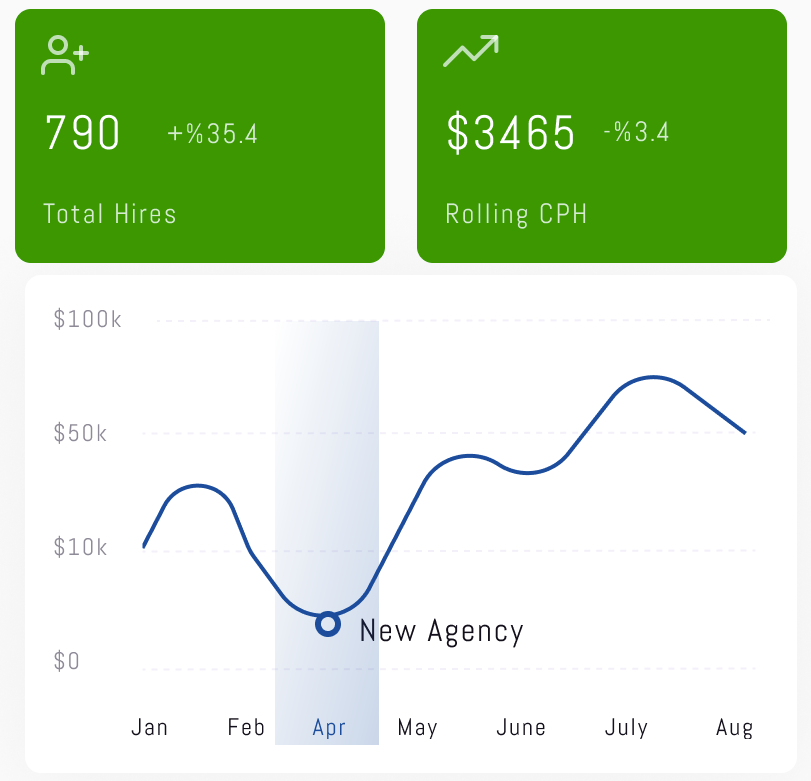
Industry averages for cost per hire (CPH) are useful indicators, but the best measure is comparing your own metrics over time.
As you adjust your recruitment strategy, track your new CPH to understand its impact. The goal isn't always to reduce CPH; a higher CPH can be justified if it results in better-quality hires.
Continuously comparing your CPH against past figures helps you determine if the costs are worthwhile and aligned with your hiring objectives.
Several factors can influence your organization’s cost per hire. Understanding these can help you optimize your recruitment process:
-
Industry and Role: Specialized industries or high-level positions often come with higher recruitment costs due to the scarcity of qualified candidates.
These roles may require more extensive search efforts, specialized recruitment agencies, or higher compensation packages to attract top talent, thus increasing the overall cost per hire. Balancing cost with the need for expertise is crucial in these scenarios.
-
Recruitment Channels: Different recruitment channels have varying costs and efficiencies. For example, using a recruitment agency typically incurs higher expenses than posting on job boards or utilizing social media.
Evaluating the effectiveness of each channel in terms of cost per hire and the quality of candidates they attract is essential for optimizing recruitment spend and outcomes.
-
Hiring Process Efficiency: A streamlined hiring process with clear steps and minimal delays can significantly reduce costs. Efficient processes minimize the time and resources spent on each hire, reducing the overall cost per hire.
Implementing standardized procedures, utilizing applicant tracking systems, and ensuring swift decision-making are key strategies to enhance hiring process efficiency and reduce associated expenses.
-
Employer Branding: A strong employer brand can attract high-quality candidates more easily, reducing reliance on expensive recruitment channels.
When your company is recognized as a desirable place to work, potential employees are more likely to seek you out, lowering the need for costly advertising or recruitment agencies. Investing in employer branding can lead to long-term cost savings and improved candidate quality.
-
Technology: Leveraging recruitment software and other technology can automate and improve parts of the hiring process, potentially lowering costs.
Tools such as applicant tracking systems, AI-driven resume screening, and online interview platforms streamline recruitment tasks, reduce manual effort, and enhance efficiency. Implementing the right technology can lead to significant savings and a more effective hiring process.
To ensure you’re achieving a good cost per hire, follow these strategies:
Evaluate the effectiveness of each recruitment channel. Focus on those that provide the best candidates at a lower cost. For example, employee referral programs often yield high-quality candidates at a lower cost compared to recruitment agencies.
To determine which channels are most effective, track the number of hires and the associated costs from each source. This includes job boards, social media, employee referrals, recruitment agencies, and career fairs. Compare the quality of candidates, time to hire, and overall cost per hire for each channel.
A faster hiring process reduces time and resources spent on each hire. To achieve this, implement clear steps and set deadlines for each recruitment stage, such as application review, initial screening, and final decision-making.
Using an applicant tracking system (ATS) can automate job postings, resume screening, and interview scheduling, significantly increasing efficiency. These strategies help streamline the process, lower costs, and enhance the candidate experience, ultimately improving your hiring outcomes.
HINT: Measure time to hire by tracking different stages such as the duration from a position becoming vacant to the new hire’s first day, and from advert closing to candidate selection. This helps identify bottlenecks in the recruitment process and areas for improvement.
Investing in a strong employer brand attracts top talent naturally and reduces reliance on costly recruitment channels. A well-regarded brand makes your company a desirable place to work, leading candidates to seek you out.
This decreases the need for expensive advertising and recruitment agency fees, ultimately lowering your cost per hire. Additionally, a positive employer brand enhances employee retention, as candidates who align with your company's values and culture are more likely to stay long-term.
Building a strong employer brand is a strategic long-term goal that reduces recruitment costs over time. Measure its effectiveness through metrics like the increase in unsolicited applications and improved employee retention rates. Additionally, monitor your company's reputation on job review sites and engagement levels on social media platforms.
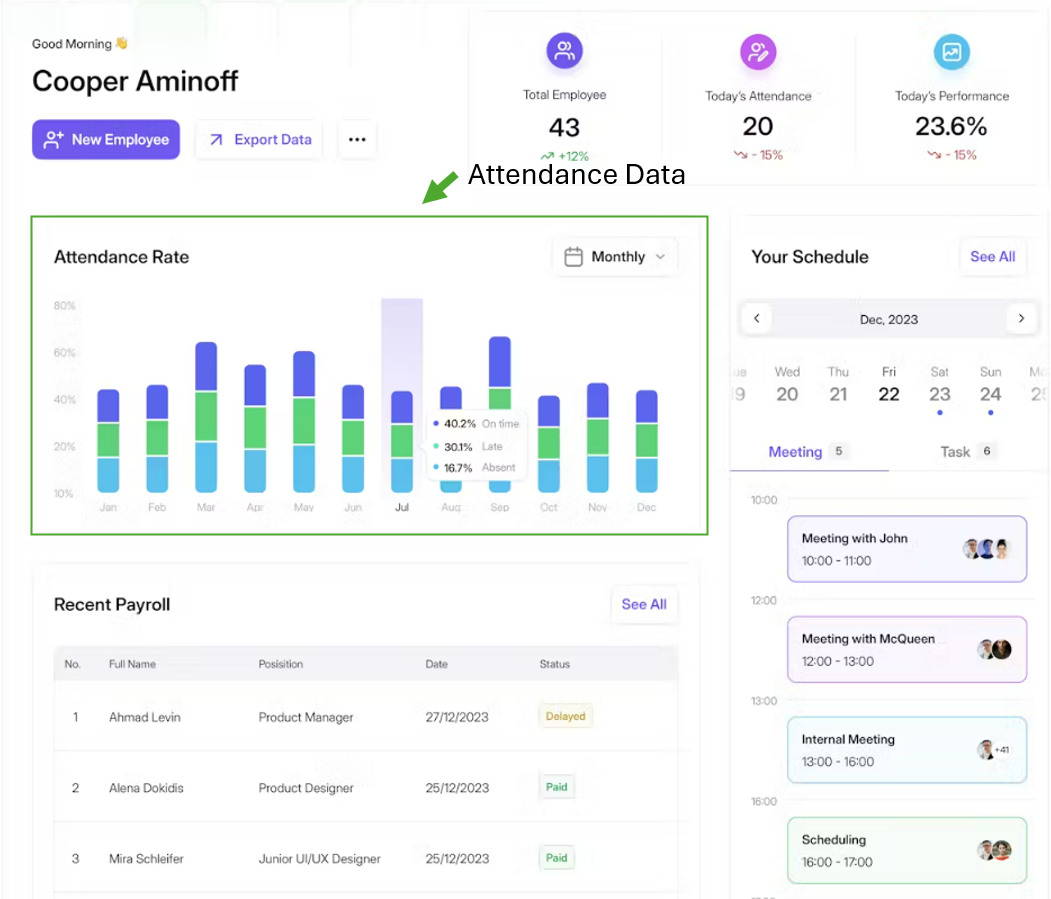
Leverage data to pinpoint where your best candidates come from and understand their hiring costs. By analyzing this information, you can refine your recruitment strategy to focus on the most cost-effective methods.
Enroll in our
People Analytics course to master these metrics and harness data effectively. You'll learn how to use analytics to optimize your hiring process, reduce costs, and improve candidate quality, ensuring your recruitment efforts are both efficient and strategic.
Use recruitment software to automate tasks like resume screening and interview scheduling, significantly reducing the workload on your HR team. This technology streamlines the hiring process by quickly identifying qualified candidates and efficiently managing interview logistics.
As a result, internal recruiting costs are lowered, allowing your HR team to focus on strategic activities such as improving candidate experience and refining recruitment strategies. Additionally, automation reduces the risk of human error, ensuring a more consistent and effective hiring process.
HINT: Use recruitment software to automate resume screening and interview scheduling, reducing HR workload and internal costs. This allows your team to focus on strategic tasks. To measure cost per hire, calculate the software’s annual cost and divide it by the total number of hires. This ensures efficiency and cost-effectiveness.